

Why Doesn’t Bread Made with Whole Wheat and Alternative Flours Rise Properly?
When you stand at the kitchen counter, have you ever looked at flour packages through a “scientific” lens? Most of us love creating wonders with the white flour we are familiar with. However, today’s shelves are filled with whole wheat flours and alternative options such as green banana flour, quinoa, and buckwheat—ingredients that can completely change the rules of the game.
Let’s take a closer look at the biochemical differences between white flour, whole wheat flour, and these emerging functional alternatives, their effects on the body, and how we can bring them into our kitchens.
White Flour vs. Whole Wheat Flour: What Are the Key Differences?
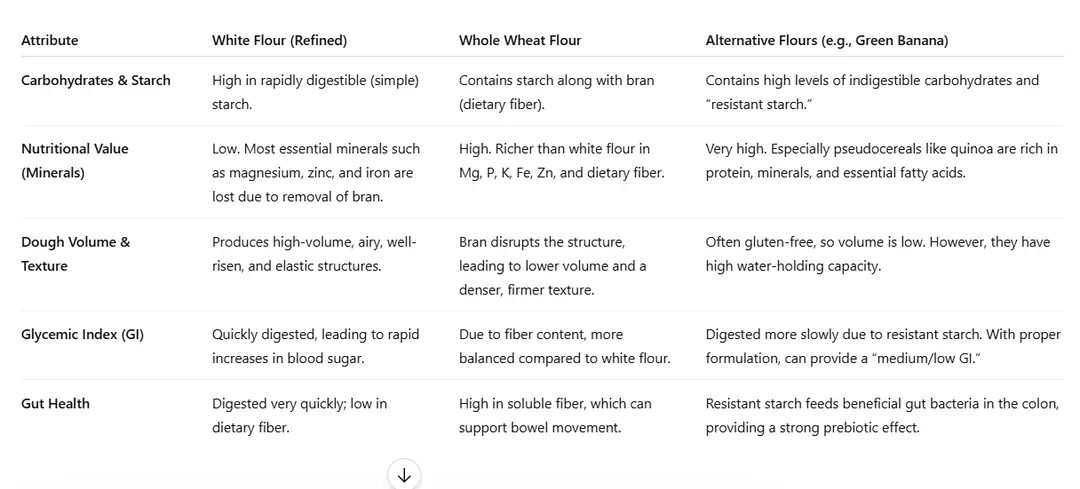
A wheat kernel consists of three main structural parts: the bran (outer layer), the germ, and the endosperm. In white flour production, the bran and germ are removed, and only the endosperm is used. As a result, white flour is rich in starch, providing a high energy value, but it has a lower nutritional profile compared to whole wheat flour.
Whole wheat flour, on the other hand, contains the entire grain (including the bran). This makes it significantly richer in essential minerals such as magnesium, phosphorus, potassium, iron, zinc, and copper compared to white flour.
Do You Know the Secret Behind Dough Rising?
Why don’t breads made with whole wheat or alternative flours rise as much as white bread? The reason is not your baking skills—it is entirely related to the structure of the flour and the journey of gas bubbles within the dough.
So, where do these gas bubbles come from?
Contrary to common belief, yeast does not create new bubbles from scratch. During kneading, air is incorporated into the dough, forming microscopic “gas cell nuclei” (air pockets). In other words, the kneading process is the most critical step in determining how many gas nuclei are formed in the dough.
The primary role of yeast is to produce carbon dioxide (CO₂) during fermentation, which inflates these already-existing tiny air pockets. As fermentation progresses, these gas bubbles become surrounded by a flexible starch–protein (gluten) network.
This is where the type of flour becomes crucial.
The coarse bran particles in whole wheat flour and the high fiber content in alternative flours physically disrupt this flexible protein network. You can think of bran and fiber as tiny needles that puncture the elastic balloons (gas cells). This significantly reduces gas retention capacity, allowing carbon dioxide to escape from the dough, resulting in bread with lower volume, tighter crumb structure, and a denser texture.
Additionally, whole wheat and functional flours have a much higher water-holding capacity compared to white flour—they absorb more water. The fibers in these flours compete with gluten proteins for water. By binding water, they prevent the gluten network from developing properly, altering water distribution within the dough and further weakening the structure.
The Power of “Resistant Starch” and Alternative Flours
Beyond conventional flours, alternatives such as green banana flour, quinoa flour, and lentil flour are introducing a new era in functional nutrition.
Green banana flour, in particular, stands out as a gluten-free ingredient containing both dietary fiber (approximately 6–15%) and a high amount of resistant starch.
Resistant starch, as the name suggests, is a type of starch that resists enzymatic digestion in the small intestine. It cannot be hydrolyzed by digestive enzymes and therefore passes intact to the large intestine.
The relatively higher amylose content in such flours can also promote the formation of resistant starch structures during thermal processing (cooking).
Glycemic Index and Digestion Rate (Starch-to-Sugar Conversion)
White flour contains a large amount of rapidly digestible starch, which is quickly broken down into glucose in the stomach and small intestine, potentially causing sharp increases in blood sugar levels.
However, when alternative flours such as green banana flour, quinoa, or lentil flour are incorporated into a recipe, the digestion dynamics change. The inclusion of green banana flour reduces the fraction of rapidly digestible carbohydrates and slows enzymatic breakdown.
Clinical studies have shown that combining green banana flour with legume flours such as yellow pea flour, in appropriate ratios, can transform bread into a more balanced, medium glycemic index product.
In short, alternative flours help slow down the conversion of carbohydrates into sugar.
Gut Health and Prebiotic Effects
So where do these undigested fibers and resistant starches go?
While white flour is low in dietary fiber, whole wheat flour, green banana flour, and other alternative flours contain both soluble and insoluble fibers in significant amounts.
These complex structures, which are not digested in the small intestine, reach the large intestine where they serve as an excellent food source for beneficial gut bacteria—acting as prebiotics.
Foods made with these high-fiber flours can support digestion, prolong satiety, and help regulate bowel movements.
Practical Tips for Use in the Kitchen
- Adjust Liquid Balance Carefully: When using whole wheat or green banana flour, their bran and high fiber content absorb water like a sponge. Therefore, you should increase the liquid content compared to recipes made with white flour.
- Create Functional Blends: To maintain bread volume while improving fiber and protein content, mix alternative flours such as quinoa or legume flours with green banana flour or starches at certain ratios (e.g., 10–15%). For example, quinoa flour is rich in essential amino acids and contains polar lipids that can support gas retention.
- Embrace the Dense Texture: Do not expect baked goods made with these flours to rise like white bread with large air pockets. The result will be denser, tighter in crumb, and slightly darker in color. This should not be seen as a flaw, but rather as an indication of a more nutritionally rich product.
References
- Ertl, K., & Goessler, W. (2018). Grains, whole flour, white flour, and some final goods: An elemental comparison. European Food Research and Technology, 244, 2065–2075. https://doi.org/10.1007/s00217-018-3117-1
- Hager, A.-S., Wolter, A., Jacob, F., Zannini, E., & Arendt, E. K. (2012). Nutritional properties and ultra-structure of commercial gluten free flours from different botanical sources compared to wheat flours. Journal of Cereal Science, 56(2), 239–247. https://doi.org/10.1016/j.jcs.2012.06.005
- Li, C., Chen, G., Tilley, M., Chen, Y., & Li, Y. (2023). Comparing bread-making properties of white and whole wheat flours from 64 different genotypes: A correlation analysis. Journal of Cereal Science, 114, 103793. https://doi.org/10.1016/j.jcs.2023.103793
- Martínez-Castaño, M., Lopera-Idarraga, J., Pazmiño-Arteaga, J., & Gallardo-Cabrera, C. (2019). Evaluation of the behaviour of unripe banana flour with non-conventional flours in the production of gluten-free bread. Food Science and Technology International, 26(2), 160–172. https://doi.org/10.1177/1082013219873246
- Steinfurth, D., Koehler, P., Seling, S., & Mühling, K. H. (2012). Comparison of baking tests using wholemeal and white wheat flour. European Food Research and Technology, 234, 845–851. https://doi.org/10.1007/s00217-012-1682-2