

Green Banana vs. Yellow Banana: Same Fruit, Completely Different Story
When buying bananas from a greengrocer or supermarket, our hands naturally reach for the bright, golden yellow ones. We patiently wait for the green and firm ones to ripen and sweeten in a corner at home. Today, let’s take a closer look at the scientific differences between green bananas and fully ripe yellow bananas, their effects on our bodies, and how we can bring this wonderful food into our kitchens.
Conversion of starch into sugar
The most fundamental difference between green bananas and yellow bananas is the remarkable change in their carbohydrate structure. While bananas in their green stage have a high starch content, their sugar content is quite low. However, as the banana ripens, enzymes called sucrose phosphate synthase come into play and convert these complex starch molecules into simpler and sweeter forms such as sucrose (sugar). The soft texture, aroma, and sweet taste of yellow bananas are the result of this biochemical process in which starch is converted into sugar.
Resistant starch content
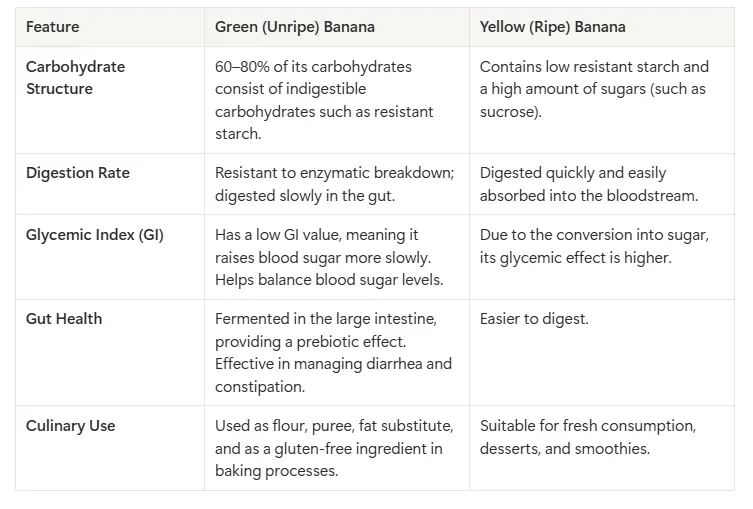
One of the most prominent topics in nutrition science, “resistant starch,” is one of the most valuable components of green bananas. Green banana products contain a significant portion of their carbohydrates—around 60–80%—as indigestible carbohydrates (resistant starch, cellulose, hemicellulose, etc.).
As the name suggests, resistant starch is a type of starch that cannot be broken down by enzymes in our digestive system, meaning it “resists” digestion in the small intestine. In yellow bananas, however, the amount of resistant starch decreases during ripening, while the amount of soluble pectin increases. This biological difference places the green form in a much more distinctive position in functional nutrition.
Glycemic index and digestion rate
The Glycemic Index (GI) is a measure of how quickly and to what extent carbohydrate-containing foods raise blood glucose levels after consumption. Due to the increased sugar content that develops during ripening, yellow bananas are digested much more quickly. On the other hand, the resistant starch found in green bananas physiologically behaves like fiber, slowing down carbohydrate digestion. This slower digestion helps prevent sudden spikes in blood sugar, supports lower glycemic index meals, and contributes significantly to the prevention or management of conditions such as type 2 diabetes.
Gut health and prebiotic effect
So where does this resistant starch go? Resistant starch that cannot be digested in the small intestine reaches the large intestine (colon), where it is fermented by beneficial gut bacteria. Acting much like dietary fiber, this structure serves as an excellent food source for our microbiome.
Practical uses in the kitchen: How can we use green banana?
Consuming yellow bananas fresh or adding them to desserts is great. But how can we incorporate green banana products into our kitchens?
- A shift in baked goods: When making cookies, cakes, bread, or pasta, you can use green banana flour instead of regular wheat flour. This allows you to increase fiber, resistant starch, and total phenolic content without compromising the sensory properties of the product.
- Gluten-free alternatives: Since green banana flour is naturally gluten-free, it is a great option for people with celiac disease or those following a gluten-free diet, and it can be used as a component in pasta or baked goods that are more resistant to enzymatic digestion.
- As a fat substitute: Pureed green banana can be used instead of fat in desserts such as cakes, helping to maintain texture and moisture. When added to meat products such as meatballs or sausages, it can increase water-holding capacity, allowing for the creation of lower-fat and healthier recipes.
Green Banana vs. Yellow Banana
Reference:
Kumari, P., Gaur, S. S., & Tiwari, R. K. (2023). Banana and its by‐products: A comprehensive review on its nutritional composition and pharmacological benefits. EFood, 4(5), e110.
Thornley, S., McRobbie, H., Eyles, H., Walker, N., & Simmons, G. (2008). The obesity epidemic: is glycemic index the key to unlocking a hidden addiction?. Medical hypotheses, 71(5), 709-714.
Falcomer, A. L., Riquette, R. F. R., de Lima, B. R., Ginani, V. C., & Zandonadi, R. P. (2019). Health benefits of green banana consumption: A systematic review. Nutrients, 11(6), 1222.